
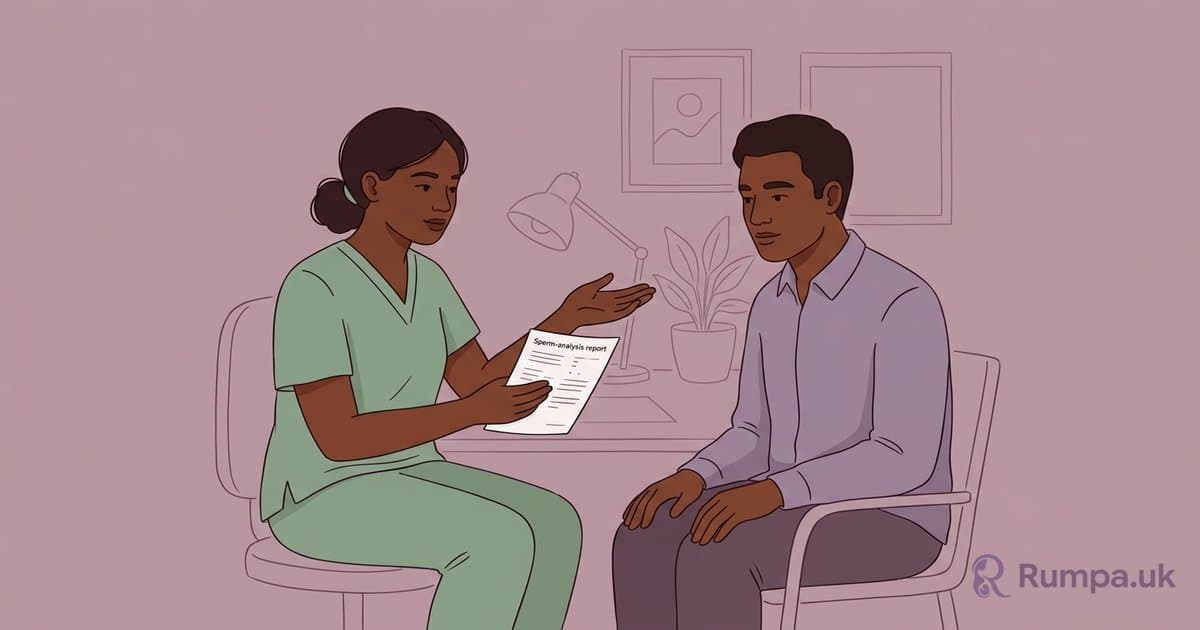
If you've been TTC for a few months, you're probably wondering, with sperm analysis, when should your partner get tested. The question carries weight. Many couples treat male testing as something to look at later, after the woman has been investigated, and that is one of the most common mistakes I see in clinic.
Male factor contributes to roughly half of fertility difficulties. A sperm analysis is half of the assessment, not an afterthought, and the answer to "when" is usually earlier than couples expect.
When Sperm Analysis Is Usually Recommended
The standard guideline is straightforward. Couples are advised to seek a fertility assessment, including a semen analysis, after 12 months of regular unprotected sex if the woman is under 35, or after 6 months if she is 35 or older. Both NICE in the UK and ASRM in the US treat semen analysis as part of the initial couple workup, not a later step.
[src]That last point matters. If you're already organising tests for one partner, you should be organising them for both at the same time. This is exactly when when to see a fertility specialist becomes relevant, because the specialist will want sperm data on day one.
Patients who come to me at month 9 sometimes ask whether requesting a sperm analysis is "too early". My answer is the same every time. If you're booking fertility tests for one partner, book them for both. The result is the same number of appointments and twice the information.
Reasons to Test Earlier Than the 12-Month Rule
Some histories shift the timeline forward. When patients ask me "when should my husband get a sperm test for TTC," I tell them the moment any of these apply, the answer is now, not in six months.
The red flags that warrant earlier testing include prior cancer treatment (chemotherapy or radiation), undescended testes in childhood, varicocele, mumps after puberty, prior chlamydia or other STIs, anabolic steroid or testosterone use, recreational drug use, and surgeries on the reproductive tract. Two or more unexplained pregnancy losses, or a female partner aged 35 or over, also justify male factor infertility testing on cycle one rather than cycle twelve.
[src]What a Sperm Analysis Actually Measures
Semen analysis explained in plain language. The lab looks at volume, sperm concentration (count), total motility, progressive motility, morphology (shape), pH, and vitality. Motility means how well they swim. Morphology means how many are shaped to do the job.
The reference values come from the WHO 2021 sixth edition manual: concentration of at least 16 million per mL, total motility of at least 42%, and morphology of at least 4% normal forms. A borderline result is not a diagnosis. Sperm count and motility can vary cycle to cycle, and sperm production runs on a 74-day cycle, so an abnormal result is usually repeated 8 to 12 weeks later.
[src] [src]How the Test Is Done (NHS vs US Pathway)
Patients often ask how is a sperm analysis done UK and US, because the route differs.
UK / NHS pathway. Your GP refers to the local NHS fertility lab. The sample is usually produced on-site or delivered within an hour of collection. The test is generally free at point of care. See the NHS infertility diagnosis pathway and our guide to the NHS fertility testing pathway for what to expect.
US pathway. Ordered by an OB-GYN, urologist, or reproductive endocrinologist. The sample is produced in-clinic or at an accredited lab. Out-of-pocket cost is typically $100 to $300. FDA-cleared mail-in and at-home options exist, but most do not measure morphology and offer only a single-snapshot result.
Practical preparation is the same either way. Abstain from ejaculation for 2 to 5 days before the sample, and reschedule if there has been a recent fever or illness.
What Happens After an Abnormal Result
A single abnormal test is not a verdict. The first step is almost always to repeat it 8 to 12 weeks later. Follow-up may include endocrine bloods (testosterone, FSH, LH, prolactin), a urology referral, and a scrotal ultrasound.
The three months between tests are useful. Lifestyle levers that can shift the next reading include stopping smoking and recreational drugs, cutting alcohol, addressing weight, reviewing medications (some antidepressants, finasteride, and any exogenous testosterone are worth a conversation with the prescriber), and reducing heat exposure (long sauna sessions, laptops on the lap). For a fuller plan, see our notes on male fertility before conception and what to do if results come back unexplained.
FAQ
Can he do a home sperm test instead?+
At-home kits can be a useful first signal, but most measure only count or motility, not morphology. If results are borderline or you have any of the early-test risk factors above, a lab analysis is still needed.
How long until results come back?+
NHS labs typically return results within 1 to 2 weeks via your GP. US clinic results often come back within a few days.
What if his count is low, can we still conceive naturally?+
Yes, often. Low does not mean zero, and many couples with mild to moderate abnormalities conceive without intervention. A repeat test and a urology review will guide next steps.
Do we need to abstain before the test?+
2 to 5 days. Less than 2 days can lower volume; more than 5 days can reduce motility.
Does cycling or laptop heat really matter?+
The evidence on short rides is modest, but prolonged heat exposure (frequent saunas, laptop on lap for hours daily) can transiently lower sperm parameters. Three months of cooler habits before a repeat test is reasonable.
References
Citations referenced inline above link to their primary sources (NHS, NICE, CDC, ACOG, ASRM, peer-reviewed journals).
If you're asking with sperm analysis when should partner get tested and you're not sure whether to start now or wait, that is exactly the kind of decision worth talking through. Either route, early testing or waiting out the 12-month window, can be the right one depending on age, cycle history, and risk factors.
Ready for a personalised fertility plan?
Book a one-to-one consultation. We'll review your history and map the next concrete step.