
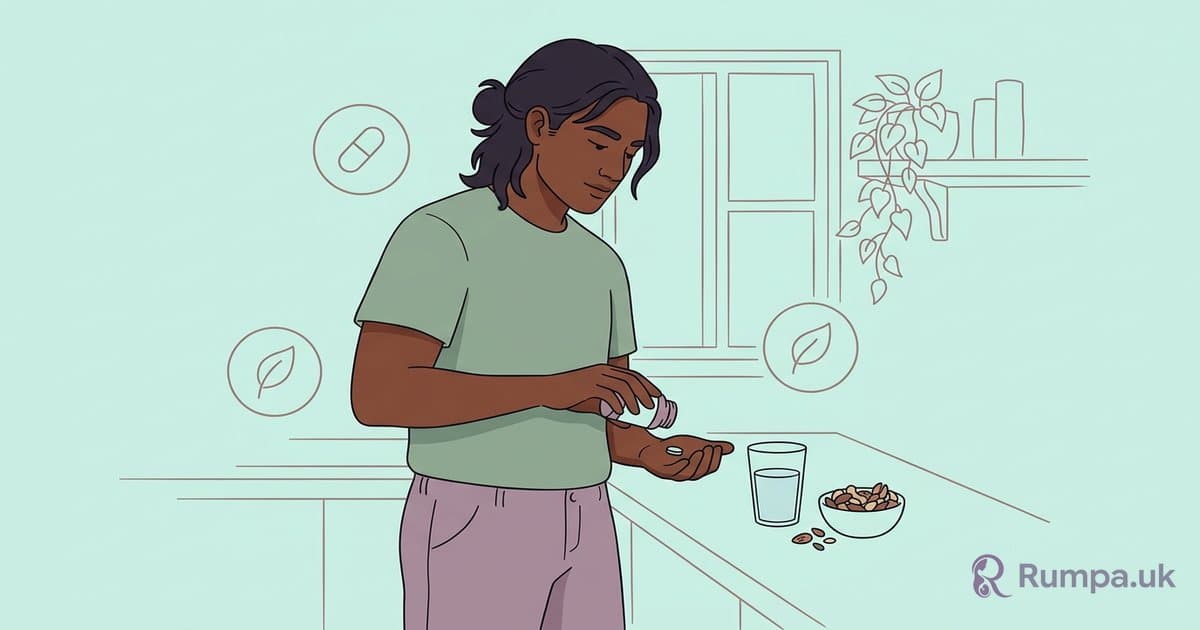
The most common scenario in my clinic: she's tracking ovulation, taking the prenatal, sleeping 8 hours, off alcohol. He's still on the lager-and-laptop-on-lap setup. Male fertility pre-conception tips rarely reach the partner who needs them, and that's a problem because sperm are made fresh on a roughly 74-day cycle. Changes started today show up in the sample three months from now. This is the post you can send to him.
If you're early in your planning, pair this with what to do 3 months before TTC on the female side. Both 90-day windows line up, which is why a pre-conception plan really is a couple's plan.
Why sperm quality changes everything in the next 90 days
Spermatogenesis, the production line that makes new sperm, runs on a 74-day clock with another 1 to 2 weeks for transit and maturation. Practically, that means a clean lifestyle stretch of three months can shift a semen analysis in measurable ways, and a rough one can drag it down just as fast.
Roughly half of fertility issues involve a male factor either alone or alongside a female factor. [src] The sperm also contributes half of the embryo's DNA. Skipping the male side and optimising only the female side is one of the most common patterns I see, and it costs couples months.
For the wider picture, see our full pre-conception health checklist.
Lifestyle changes that actually move semen parameters
Sperm quality lifestyle changes are unglamorous but well-evidenced. The big six are smoking, alcohol, weight, exercise, sleep, and heat exposure.
Smoking and vaping. Both lower sperm count, motility, and morphology, and raise DNA damage. [src] Stopping is the single highest-yield change.
Alcohol. Keep under 14 UK units a week, ideally lower during TTC. Heavy drinking lowers testosterone and damages sperm.
Weight. A BMI over 30 is associated with lower testosterone, higher oestrogen, and more sperm DNA fragmentation. Sustainable loss, not crash diets, is the play.
Exercise. Three to four moderate sessions a week helps. Extreme endurance training, repeated long-distance cycling, or aggressive cutting cycles can hurt rather than help.
Sleep. Aim for 7 to 8 hours. Testosterone is largely a night-time hormone. Chronic short sleep blunts it.
What can my partner do to boost fertility starting tonight? Stop smoking, cap alcohol, get the laptop off his lap, and book sleep in like a meeting. That's most of the gain in five sentences.
Heat, environment, and the underrated daily exposures
Sperm production needs the scrotum a couple of degrees cooler than core body temperature. Modern life works against that.
- Saunas, hot tubs, and very long hot baths: limit during the 90-day window.
- Laptops on the lap for hours: use a lap desk or sit at a table.
- Tight underwear and tight cycling shorts: switch to looser fits where possible.
- Long commutes with seat heaters on full or sun on the lap: a small thing, easy to fix.
Environmental exposures are noisier in the evidence base. The signal is clearest for tobacco, heavy alcohol, and high pesticide exposure. BPA and phthalates are plausible but less consistent. Don't lose sleep over a plastic kettle, do reduce the exposures you control.
Long-distance cycling deserves its own line. Recreational riding is fine. Several hours a day on a hard saddle, especially during a competitive season, has shown effects on semen parameters in some studies. If he's a serious cyclist and you're in a tight TTC window, an ergonomic saddle and a couple of recovery days a week are reasonable changes.
Sperm DNA fragmentation, the test most men have not heard of
A standard semen analysis measures count, motility, morphology, and volume. It tells you how many sperm there are and how they look and move, but not how intact their DNA is. Sperm DNA fragmentation is a separate test that measures broken or damaged DNA inside the sperm head.
This matters because a man can have a "normal" semen analysis and still have high DNA fragmentation, which is linked to recurrent miscarriage, failed IVF cycles, and unexplained infertility. [src]
Worth asking about if any of the following apply: recurrent miscarriage, failed IVF or ICSI cycles, unexplained infertility after a year of trying, paternal age over 40, or a known history of varicocele, infection, or chemotherapy.
How long before TTC should men make changes? Three months is the minimum because of the spermatogenesis cycle. Six months is better if there's an existing problem on the analysis or a history of loss, because lifestyle and supplement changes compound across two full cycles.
If the standard analysis or fragmentation result is abnormal, the next step is usually a urology or andrology referral, not another round of supplements. [src] This is also a good moment to look at unexplained infertility next steps.
Male pre-conception supplements, what the evidence actually supports
Male pre-conception supplements have moderate but real evidence behind a small list of ingredients. The strongest case sits with antioxidants in combination, since oxidative stress is one of the main pathways through which lifestyle damages sperm.
The shortlist that comes up in trials and meta-analyses:
- Zinc, important for testosterone and sperm production
- Selenium, supports motility
- CoQ10, antioxidant with reasonable data for count and motility
- Vitamin C and vitamin E, antioxidants, usually in combination
- Folate, around 400 to 800 micrograms
- Omega-3 (EPA and DHA), supports membrane quality
A male fertility blend that contains most of these in standard doses is reasonable. Avoid mega-dose stacks and anything marketed as a "testosterone booster" with proprietary blends, the dosing is opaque and some ingredients work against fertility.
Ready for a personalised fertility plan?
Book a one-to-one consultation. We'll review your history and map the next concrete step.
What this means for you
Male fertility pre-conception tips aren't optional extras. Three months is the minimum useful window, and the simple list (stop smoking, drop alcohol, lose excess weight, sleep 7 to 8 hours, keep the scrotum cool, take an evidence-based supplement) covers most of the achievable gain. If you suspect a male factor or you've had a loss, ask about a full semen analysis and DNA fragmentation early, not after another six months of trying.
If you'd like a tailored 90-day pre-conception plan that covers both partners and accounts for any existing fertility test results, that's a useful joint consult to book.
How long before TTC should my partner start making changes?+
How do I get a semen analysis on the NHS?+
Is sperm DNA fragmentation testing available privately in the UK?+
Which male fertility supplement is best?+
Do hot tubs really lower sperm count?+
References
Citations referenced inline above link to their primary sources (NHS, NICE, CDC, ACOG, ASRM, peer-reviewed journals).