
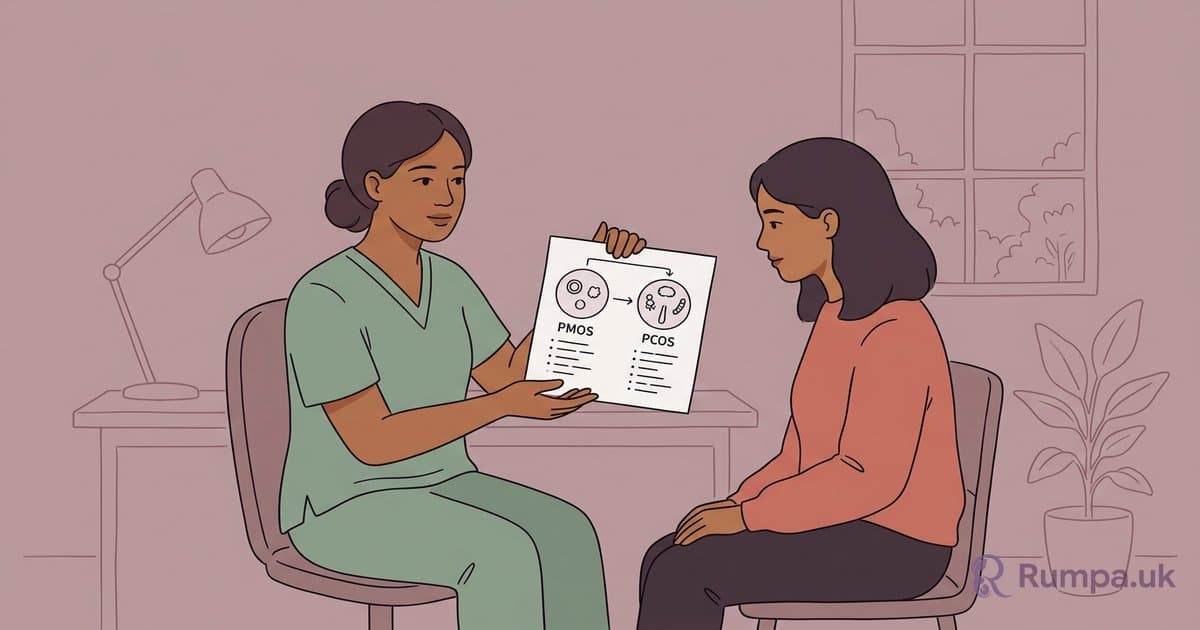
If you searched PMOS vs PCOS what's the difference, you've probably just seen the news that the condition has been officially renamed. That can feel unsettling, especially if you're TTC and you've been managing a PCOS diagnosis for years. A label you'd come to terms with appears to have moved without you.
The short version is reassuring. PMOS vs PCOS, what's the difference is mostly a question about the name, not the condition.
The Short Answer (Lead With Clarity)
PMOS stands for Polyendocrine Metabolic Ovarian Syndrome. It is the same condition you knew as PCOS, with a more accurate name. The 2026 international consensus, published in The Lancet and announced by the Endocrine Society, did not redraw the disease. It renamed it.
[src]Bold takeaway: if you have a PCOS diagnosis today, you have a PMOS diagnosis tomorrow. Same condition, more accurate label. Your treatment plan does not need to change because of the name.
The PCOS renaming PMOS does have implications, but they are mostly about how the condition is described going forward and how primary care, specialists, and patient education catch up. For anyone already TTC, the practical impact in the next 12 months is small. For background on conception odds with this diagnosis, see our overview on can you get pregnant with PCOS.
Why the Name Changed
The old name carried two problems. "Polycystic" implied pathological ovarian cysts, but what an ultrasound actually shows is arrested follicles, not cysts. And "ovary syndrome" understated the biology. The condition involves insulin resistance, androgen excess, and neuroendocrine signalling. Polycystic metabolic ovarian syndrome is endocrine and metabolic, not only ovarian.
Diagnostic delay affected up to 70% of patients under the old framing, partly because the name pointed clinicians at imaging instead of metabolic workup. The renaming process took roughly a decade, involved around 22,000 experts, and drew on more than 14,000 patient and clinician survey responses.
[src]What Stays the Same in Diagnosis
The PCOS diagnostic criteria update is not actually new. The Rotterdam criteria, refined by the 2023 International Evidence-Based Guideline, still apply. Diagnosis in adults still requires two of three: clinical or biochemical hyperandrogenism, ovulatory dysfunction, and polycystic ovaries on ultrasound (or elevated AMH as a 2023 alternative).
If you already have a diagnosis, you do not need a new ultrasound, a new blood test, or a new GP appointment to "convert" it. For readers still in the diagnostic process, our guide to how to know if you have PCOS walks through the workup step by step.
[src]Patients who come to me worried they need to redo every test, I reassure them. The criteria didn't change. Only the name did. Your existing records remain valid.
Does PMOS Change Treatment or TTC Plans?
Patients ask me does PMOS change PCOS treatment, and the honest answer is no, not in any meaningful clinical sense.
For TTC, ovulation-induction options are unchanged. Letrozole remains first-line, clomiphene is an alternative, and inositol or metformin are adjuncts where indicated. Our overview of PCOS fertility treatment options covers the decision tree.
For metabolic care, the new name actually reinforces what good clinicians were already doing: screening for insulin resistance, lipid profile, blood pressure, and type 2 diabetes risk. For pregnancy after conception, PCOS / PMOS is still a recognised risk factor for gestational diabetes, which is why the PCOS to gestational diabetes link matters even more once a pregnancy is confirmed.
[src]Is PMOS Replacing PCOS Officially Everywhere?
Patients ask is PMOS replacing PCOS officially, and the answer is yes by international consensus, but with a rollout window. Adoption into electronic health records, insurance codes, NHS clinical letters, and patient-facing materials will happen over the next 12 to 24 months.
Expect both names to coexist for a while. Your records may say PCOS, PMOS, or both. Either is correct.
UK readers. Your GP letter may still read PCOS for now. NICE guidance and NHS coding will update over the next year. This is not an error in your notes.
US readers. ICD-10 coding will need to catch up before insurance documentation reflects the new name. Your existing diagnosis and prior authorisations remain valid.
FAQ
Do I need to ask my GP to update my diagnosis to PMOS?+
No. The diagnosis remains valid under either name. Updates will roll out through NHS systems over the next 12 to 24 months without action from you.
Will insurance or NHS coding change?+
Coding bodies are working through the update. For now, PCOS coding still applies. Existing prior authorisations and prescriptions remain valid.
Does this affect my fertility treatment plan?+
No. Letrozole, clomiphene, metformin, and inositol guidance are unchanged. If you are on a TTC plan, continue as advised.
Is the new name on NICE guidance yet?+
NICE is expected to update its guidance over the next 12 to 18 months. Until then, the PCOS pages still apply.
Why was the old name considered inaccurate?+
The ovaries show arrested follicles, not true cysts, and the condition is endocrine and metabolic, not only ovarian. The new name reflects that.
References
Citations referenced inline above link to their primary sources (NHS, NICE, CDC, ACOG, ASRM, peer-reviewed journals).
The PMOS vs PCOS what's the difference question has a calmer answer than the headlines suggest. Same condition, better name, same care. If you are TTC and want to talk through what your specific diagnosis means for your next cycle, an online consultation is a good place to start.
Ready for a personalised fertility plan?
Book a one-to-one consultation. We'll review your history and map the next concrete step.