
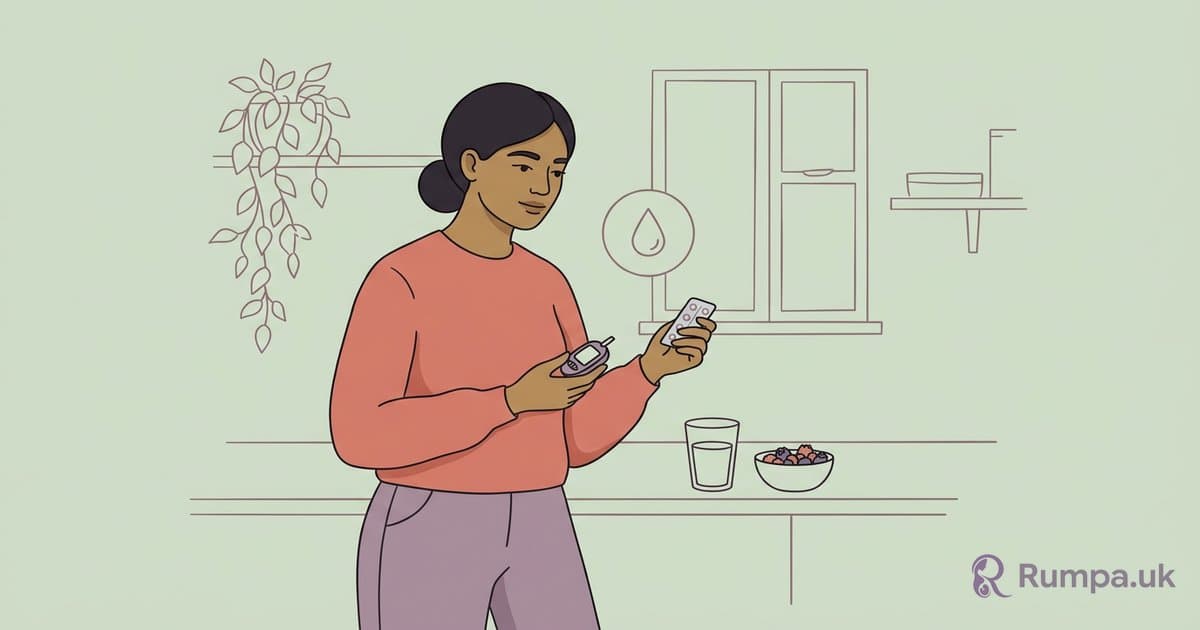
One question keeps coming up in PCOS clinics: why am I not ovulating when my hormones seem treatable? The PCOS insulin resistance fertility link is the answer for most women. Roughly 65 to 80 percent of women with PCOS have some degree of insulin resistance, and that single issue often drives the irregular cycles that brought them in.
This post explains how the chain works, how to actually test for insulin resistance, and what the result changes in your fertility plan. For the broader treatment view, start with the full PCOS fertility treatment options.
How Insulin Resistance Drives PCOS Infertility
The mechanism is simpler than the textbook makes it sound.
When cells stop responding well to insulin (insulin resistance), the pancreas compensates by releasing more. The result is chronically high circulating insulin, called hyperinsulinaemia. Insulin acts on the ovary in two ways: it stimulates the theca cells to make more androgens, and it suppresses the liver's production of sex hormone binding globulin (SHBG), which raises free testosterone in the bloodstream.
Excess androgens disrupt follicle selection. The dominant follicle that should emerge each cycle doesn't, ovulation stalls, and you get the classic PCOS pattern: long cycles, skipped periods, and the occasional very heavy bleed after a long gap. [src]
So how does insulin resistance stop ovulation? Through the androgen surge that interrupts the LH and FSH signalling needed for follicle dominance. This is also why PCOS responds better to insulin-targeted treatment than to oestrogen-only fixes; you're treating the upstream driver, not the downstream noise.
This is the reason metformin and inositol earn their place in PCOS fertility plans, and the reason a contraceptive pill (which suppresses ovulation by design) doesn't move the needle on the underlying TTC problem.
How to Test for Insulin Resistance with PCOS
The HOMA-IR test is the easiest first pass. It's calculated from two fasting blood values, taken together first thing in the morning after at least 8 hours of no food.
HOMA-IR = (fasting insulin in microIU/mL multiplied by fasting glucose in mmol/L) divided by 22.5.
A HOMA-IR at or above 2.71 is the cut-off most often used in PCOS and IVF research to flag insulin resistance. [src] Some labs use slightly different thresholds, so always read your result alongside the lab's reference range and the rest of your clinical picture.
The more sensitive test is the oral glucose tolerance test (OGTT) with paired insulin levels. You drink a 75 g glucose load and have blood drawn at 0, 60 and 120 minutes (sometimes more). It picks up the insulin spike that fasting values alone can miss, and it's the right test in lean PCOS where the fasting numbers often look unremarkable.
HbA1c is useful but limited. It picks up established dysglycaemia (prediabetes, diabetes) but is too crude for early insulin resistance.
So, how to test for insulin resistance with PCOS in practice:
- UK: Ask your GP for fasting insulin alongside fasting glucose so HOMA-IR can be calculated. Many GPs don't run fasting insulin by default and may need it requested specifically. If they decline, a private blood panel is straightforward.
- US: Ask your OB-GYN or endocrinologist for the same pairing. Coverage varies, but most insurance plans include fasting insulin and glucose when PCOS is on the chart.
Many primary care doctors order fasting glucose and HbA1c by default and stop there. For PCOS work-up, you specifically need fasting insulin too. Without it, HOMA-IR can't be calculated.
What Insulin and Ovulation Look Like in Real Cycles
The insulin and ovulation picture on the ground is messy.
You'll see anovulatory cycles, long cycles of 35 days or more, and very heavy bleeds after a long gap. OPKs (ovulation prediction kits) misfire in PCOS because chronically elevated baseline LH gives false positives, sometimes daily for weeks. BBT often shows no clear biphasic shift because there's no luteal-phase progesterone rise to read.
A day-21 (or 7-days-before-period) progesterone is the cleanest test of whether you actually ovulated that cycle. In PCOS with insulin resistance, it's often low.
For the practical version of tracking when cycles are this irregular, see PCOS cycle tracking for ovulation.
Metformin for Insulin Resistance and Fertility
Metformin is the first-line pharmacological insulin sensitiser in PCOS. It lowers hepatic glucose production, improves peripheral insulin sensitivity, and reduces hyperinsulinaemia, which in turn lowers ovarian androgen output and often restores ovulation.
The typical dose ramp-up is 500 mg once daily for a week, increasing to 500 mg twice or three times daily, with a usual target of 1500 to 2000 mg daily. Side effects (nausea, loose stools, bloating) cluster in the first 2 to 4 weeks and settle for most people. The extended-release version is gentler.
The evidence summary worth knowing:
- Metformin alone is less effective than letrozole or clomiphene for ovulation induction in PCOS.
- Combination therapy (metformin plus clomiphene) helps in clomiphene-resistant PCOS.
- It's sometimes continued through early pregnancy in patients with insulin resistance, decided case by case.
Metformin is not a weight loss drug. In PCOS, it's an insulin sensitiser. Framing it as a diet pill misses the point and sets the wrong expectation for the patient who hopes to see a number on the scale move quickly.
For the head-to-head with the most common alternative, see inositol vs metformin for PCOS fertility. The 2025 PubMed review summarises where metformin fits in current PCOS care. [src]
Lifestyle Levers That Actually Shift Insulin Resistance
The four levers that consistently move HOMA-IR in PCOS, in roughly the order of impact I see in clinic:
Strength training plus regular movement. Resistance work improves insulin sensitivity more than cardio alone. Two or three sessions a week, plus daily walking, beats long cardio-only schedules.
Low-glycaemic eating pattern. Protein and fibre at every meal, whole grains over refined, less sugar-sweetened drink intake. The pattern matters more than any one "PCOS food." Our companion piece on a PCOS diet to conceive walks through the plate-level detail.
Sleep. Under-discussed and high-impact. Even short-term sleep restriction worsens insulin sensitivity independent of diet. Seven to nine hours, regular timing.
Inositol. Myo-inositol plus D-chiro inositol in a 40:1 ratio has modest but reasonable evidence for improving ovulation in PCOS, often used as an alternative or addition to metformin.
The 2023 International PCOS Guideline puts lifestyle first in the treatment hierarchy for ovulatory dysfunction in PCOS, with pharmacotherapy added based on response and patient preference. [src]
FAQ
Do all women with PCOS have insulin resistance?+
No. Roughly 65 to 80 percent do, with the rate higher in PCOS plus higher BMI and lower (but still meaningful) in lean PCOS. The only way to know your number is to test.
What is a normal HOMA-IR?+
Most labs treat under 1.9 as low risk, 1.9 to 2.7 as a grey zone, and 2.71 or above as suggestive of insulin resistance in PCOS research cohorts. Always read your number against the lab's own reference range.
Does inositol work as well as metformin?+
For some patients, yes, particularly those with milder insulin resistance who don't tolerate metformin side effects. For more severe insulin resistance or established prediabetes, metformin has the stronger evidence base.
Can lean PCOS have insulin resistance?+
Yes. Lean PCOS often has insulin resistance that fasting values miss; an OGTT with paired insulin picks it up. Don't assume low BMI rules it out.
How long until metformin restores ovulation?+
Once a stable dose is reached, ovulation often returns within 1 to 3 cycles, though some patients need 4 to 6 months. If there's no response by 6 months, it's reasonable to add or switch to letrozole.
References
Citations referenced inline above link to their primary sources (NHS, NICE, CDC, ACOG, ASRM, peer-reviewed journals).
The PCOS insulin resistance fertility loop is treatable, often without jumping straight to IVF. Ask for fasting insulin and glucose so HOMA-IR can be calculated, address sleep and movement, and talk to your doctor about whether metformin or inositol fits your numbers. If you'd like help mapping your labs to a step-by-step PCOS fertility plan, that's the conversation we have in a consult.
Ready for a personalised fertility plan?
Book a one-to-one consultation. We'll review your history and map the next concrete step.