
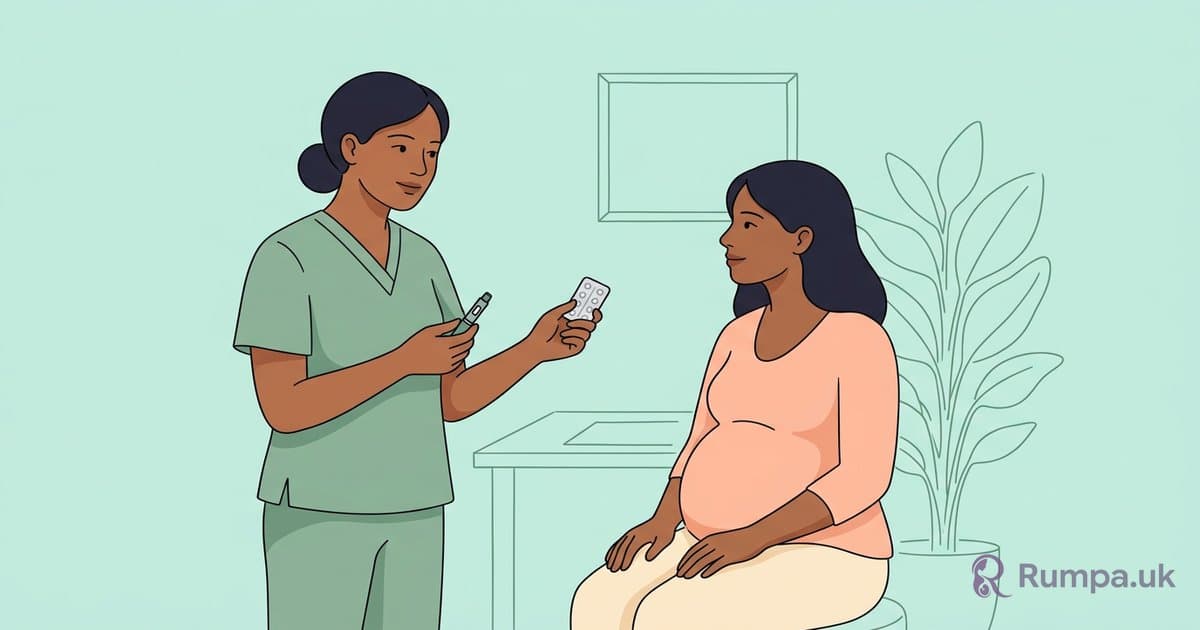
When patients hear "we need to start medication", the first question is almost always about gestational diabetes insulin vs metformin and which one is safer for the baby. The honest answer: both are widely used, both have solid safety records, and the first-line choice depends partly on your numbers and partly on which country you're being treated in.
Here's what each medication actually does, why NICE and ACOG give different first-line advice, and what to expect day-to-day on either pathway.
How the GD Medication Decision Is Made
Diet, movement, and home glucose monitoring is the starting point for almost everyone after a positive gestational diabetes diet plan review and the OGTT diagnosis (see when the gestational diabetes test is done for the timing). Medication enters the conversation when fasting or post-meal glucose targets are missed roughly 30% of the time over one to two weeks, despite consistent dietary effort. [src]
So, will I need insulin for gestational diabetes? Maybe, maybe not. About half of women on dietary management alone reach the end of pregnancy without medication. Of those who do need medication, a substantial share are managed on metformin only; the rest add or switch to insulin. The two main drivers are fasting glucose (the hardest number to control with diet alone, because it reflects overnight liver glucose production) and how late in pregnancy the diagnosis comes (later diagnoses leave less time for dietary effect before placental hormones peak).
For patients with PCOS, this decision often arrives earlier in pregnancy because of the underlying PCOS and gestational diabetes link, and metformin may already be familiar from pre-pregnancy use.
Needing medication for gestational diabetes is biology, not behaviour. Patients who come to me convinced they "failed" the diet phase, I have to gently dismantle that. The placenta releases hormones that drive insulin resistance, and for some women, no amount of dietary effort overcomes that. Medication is just the next tool, not a verdict on your willpower.
Metformin Pregnancy Safety, What the Data Shows
Metformin (a tablet, taken with meals, twice or three times daily) improves how your cells respond to insulin and lowers the amount of glucose your liver releases overnight. It's well-established as a first-line GD medication in the UK and as an alternative option in the US.
Is metformin safe throughout pregnancy? The metformin pregnancy safety dataset is large and reassuring for short-term outcomes. Children followed through early school age show no consistent adverse effects on growth or development. Longer-term follow-up data is still maturing, and a few studies have flagged subtle differences in childhood adiposity worth monitoring. This is why guidelines continue to evolve.
Practical notes from clinic: gastrointestinal side effects (nausea, loose stools, metallic taste) are common in the first one to two weeks and usually settle. Take it with food, start at a low dose, and increase gradually. Modified-release versions are gentler if standard metformin doesn't agree with you.
Metformin does cross the placenta. We say this transparently because patients deserve the full picture: it's not the same pharmacokinetic profile as insulin, but it isn't a zero-transfer drug. The safety conversation factors that in.
About half of GD pregnancies started on metformin will need insulin added at some point as placental hormones rise. That's expected, not failure.
Insulin Injection in Pregnancy, the Gold Standard Explained
Insulin has the longest safety record of any GD medication, by decades. It does not cross the placenta, which is why ACOG and the ADA still position it as preferred first-line in the US. [src]
A typical insulin injection in pregnancy regimen uses rapid-acting insulin (NovoRapid, Humalog) before meals to handle post-meal spikes, and sometimes intermediate-acting insulin (Insulatard, Humulin I) at bedtime to control fasting glucose. Some women only need one of these, not both. The pen device is small, the needle is fine, and most patients learn the technique in a single clinic session.
Doses rise through pregnancy as placental hormones peak, typically from around 24 weeks through 36 weeks. This is biology, not a sign anything is wrong. Doses then drop sharply after the placenta is delivered, which is why insulin is usually stopped within hours of birth for GD specifically.
Side effects: the main one is hypoglycaemia (low blood sugar), which is rare on the doses used for GD but worth knowing to recognise. Your team will teach you what to watch for and what to keep nearby.
UK vs US, Why Guidelines Disagree on First-Line
This is one of the clearest examples in obstetric medicine of identical data producing different professional society positions.
NICE (UK) has recommended metformin as first-line pharmacological treatment for gestational diabetes since the 2015 update, reinforced in subsequent reviews. [src] Insulin is added if metformin alone doesn't meet targets, or used first if metformin is contraindicated or declined.
ACOG and the ADA in the US position insulin as preferred first-line, with metformin as an acceptable alternative when insulin is declined, can't be afforded, or isn't accessible. SMFM (Society for Maternal-Fetal Medicine) sits slightly closer to NICE, accepting metformin as a reasonable first-line option. [src]
The same patient with the same fasting glucose can be started on metformin in Manchester and insulin in Boston. Both are evidence-based decisions. The transatlantic difference comes down to how each society weighs long-term safety data, placental transfer, and patient experience.
On the NHS, expect metformin first-line under NICE NG3, with insulin added if targets aren't met within one to two weeks. You'll be under joint care with diabetes midwifery, often with a continuous glucose monitor in higher-risk pregnancies.
In the US, insulin is typically offered first under ACOG and ADA guidance, with metformin as an alternative if you prefer oral medication or insulin access is difficult. Insurance coverage and pump or pen costs are a real conversation; bring them up with your team.
What Changes Day-to-Day Depending on the Choice
Logistics differ. Metformin is tablets, stored at room temperature, easy to travel with, no fridge needed. Insulin is pen devices, refrigerated when unopened, room temperature once in use, with a kit to take on flights and a doctor's letter for airport security.
Monitoring is the same on either: finger-prick glucose four to six times a day in most pathways (fasting plus one or two hours after each main meal). Continuous glucose monitors are increasingly common in both metformin- and insulin-treated GD, especially when targets are tight or numbers are erratic.
Birth plan implications are usually modest. Most centres treat metformin-only and insulin-treated GD similarly for delivery timing, with individual variation based on glucose control, baby's growth, and any other complications. Insulin-treated GD with poorly controlled numbers may push toward earlier induction discussions; metformin-only GD with stable numbers often follows standard timing.
If fasting glucose is your main problem, safe bedtime snacks for gestational diabetes can sometimes help on the dietary side before reaching for a dose increase.
What This Means for You
Gestational diabetes insulin vs metformin is a genuine choice, not a hierarchy. NICE and ACOG disagree on first-line based on the same evidence, both medications have decades or years of safety data, and the practical question is which one fits your numbers, your tolerance, your pregnancy timeline, and your clinic's pathway.
If your team has recommended one and you want a second opinion before starting, or you're switching between the UK and US systems and need to make sense of conflicting advice, that's a fair conversation to bring to a telemedicine consultation.
Ready for a personalised fertility plan?
Book a one-to-one consultation. We'll review your history and map the next concrete step.
Will I always need insulin if I start metformin?+
Not always. Around half of women on metformin for GD will need insulin added before delivery, usually because placental hormones rise enough to outpace metformin's effect. The other half complete pregnancy on metformin alone. It's not a guaranteed escalation.
Can I switch from insulin to metformin if I find injections difficult?+
Sometimes. If your numbers are well-controlled and your team agrees, a trial of metformin can be reasonable. Switching is more often the other direction (metformin to insulin) as pregnancy progresses, but it's worth raising if injection burden is a problem.
What are the main side effects of each?+
Metformin: nausea, loose stools, metallic taste, usually settling in one to two weeks. Insulin: low blood sugar (rare on GD doses but possible), occasional injection-site reactions. Both have good overall tolerability for the short pregnancy timeframe.
Can I breastfeed on metformin or insulin?+
Yes, both are compatible with breastfeeding. Insulin is broken down in the gut so there's no infant exposure through milk. Metformin is excreted in milk in trace amounts and is widely considered safe during breastfeeding.
Do I stop medication right after birth?+
For GD specifically, yes, usually within hours. The placenta is the driver of GD insulin resistance, and once it's delivered, glucose typically normalises. A postpartum OGTT at 6-13 weeks checks whether glucose has fully returned to normal or whether ongoing follow-up is needed.
References
Citations referenced inline above link to their primary sources (NHS, NICE, CDC, ACOG, ASRM, peer-reviewed journals).