
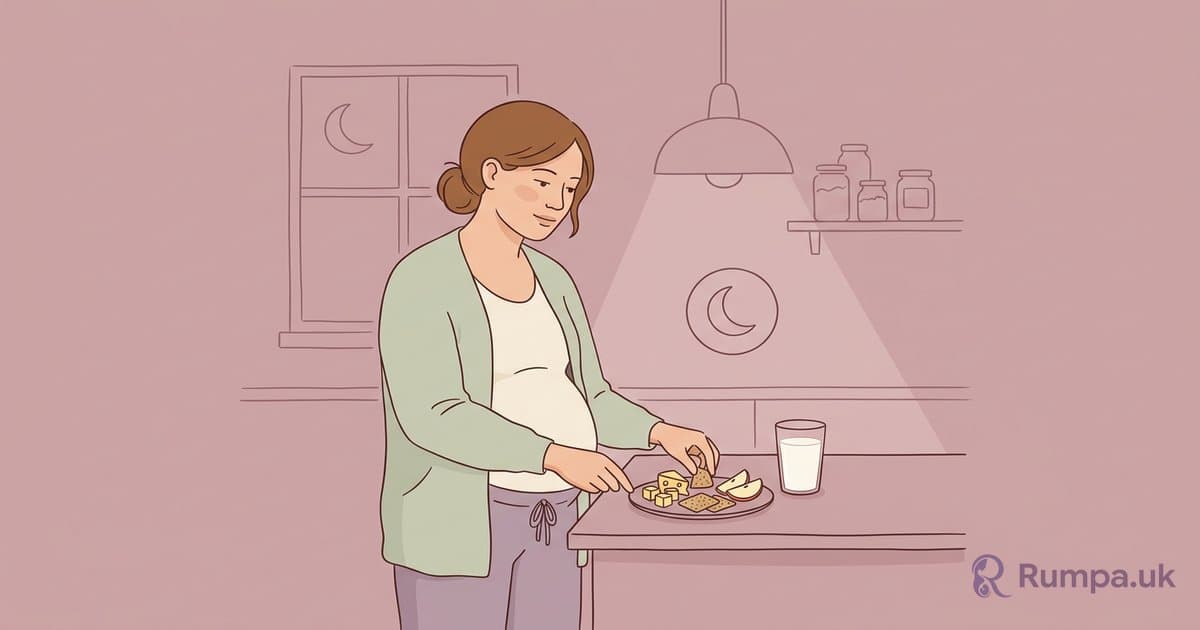
Patients ask whether gestational diabetes safe snacks bedtime actually work, because the morning fasting number keeps reading high no matter what they ate at dinner. Fasting glucose is the hardest number in GD to influence with food alone, but the right bedtime snack genuinely helps in many cases. Here's how to choose one, how to troubleshoot when it isn't working, and how to know when to ask your team about medication.
If you're newer to gestational diabetes, this is the eating side of a bigger picture. The full gestational diabetes diet plan sits one level up, and explains how carbohydrates, protein, and meal timing across the day all feed into the numbers you log.
Why fasting glucose is the hardest GD number to move
Fasting glucose in pregnancy doesn't behave like post-meal glucose. Two things happen overnight that you can't out-diet.
First, the dawn phenomenon: in the early morning, the body releases cortisol and growth hormone to wake you up, which tells the liver to release stored glucose. In a non-pregnant body this is barely noticeable. In a pregnancy already running on placental insulin resistance, it shows up clearly on a 7am fingerprick. [src]
Second, placental hormones (human placental lactogen, progesterone, oestrogen) rise through pregnancy and progressively block your insulin. By the third trimester, your insulin needs may be two to three times pre-pregnancy levels. The placenta, not the dinner plate, is the strongest variable.
This is why eating less at dinner often doesn't help. A too-low evening intake can actually push the liver to dump more glucose overnight, which raises fasting numbers further.
What makes a bedtime snack safe with GD
The reliable formula is 15 to 30 grams of complex carbohydrate paired with 7 to 15 grams of protein, eaten 30 to 60 minutes before sleep. [src] A little fat is welcome too, since it slows gastric emptying further.
The logic is bedtime snack carb-protein pairing physiology. A naked carb, say a banana or a slice of white toast, hits the bloodstream as a sharp glucose spike and is gone by 2am, leaving the liver to wake up and pour out glucose on its own. Pair the same carb with protein, fat, and fibre, and absorption flattens out across the night.
Avoid before bed:
- Fruit on its own, especially tropical fruit
- Fruit juice or smoothies
- White crackers, white bread, plain rice cakes
- Sweetened or "fruit" yoghurts
- Sugary milky drinks, including most hot chocolates
For the wider testing schedule, see when the gestational diabetes test is done. [src]
Safe bedtime snack examples that follow the rule
What to eat before bed with gestational diabetes is less about a fixed list and more about pairing. Once you've internalised the formula, your own kitchen gives you dozens of options. These are the ones patients land on most often.
- Greek yoghurt (full fat, unsweetened) with a small handful of berries. Around 8 to 12g carbs, 15g protein.
- Wholegrain toast (1 slice) with peanut or almond butter. Around 18g carbs, 8g protein.
- Hummus with raw veg sticks and 2 oatcakes. Around 20g carbs, 7g protein.
- A small apple with 30g cheese. Around 18g carbs, 7g protein.
- A hard-boiled egg with 2 oatcakes. Around 15g carbs, 8g protein.
- A glass of milk (200ml) with a small handful of mixed nuts. Around 12g carbs, 10g protein.
- Cottage cheese with a tablespoon of pumpkin seeds. Around 6g carbs, 14g protein.
- Hummus on 2 wholegrain crackers with a few cherry tomatoes. Around 18g carbs, 7g protein.
Why your fasting sugar may still be high
Why is my fasting sugar high with GD even when I'm doing everything right? Three common reasons sit behind most cases.
The snack is too small. A 5g protein nibble doesn't carry overnight. Push protein toward 10 to 15g.
The snack is too sweet. A "healthy" yoghurt with fruit on the bottom is functionally a dessert. Check the label, anything over 5g of sugar per 100g is high.
Dawn phenomenon dominates. When placental hormones are the main driver, a perfect snack still won't fully flatten the morning number. The signal here is that you've tried three or four different appropriate snacks over a week and the fasting reading stays above target.
Other contributors worth noticing: a late evening walk that you skipped, broken sleep, an early-pregnancy cold or UTI, and high evening stress (a 9pm work call lights up cortisol). Sleep position rarely matters, the others often do.
When snacks are not enough, the medication conversation
Most UK clinics consider starting medication when around 30% of your fasting or post-meal readings sit above target across one to two weeks of honest logging. That threshold matters because it stops the conversation being about a single bad night.
If your team raises insulin or metformin, that isn't a punishment. The placenta keeps making more hormones every week, and at some point food and movement can't out-run it. We cover the choice in detail in insulin vs metformin for gestational diabetes.
A small randomised trial in pregnant women with GDM showed a structured bedtime snack regimen modestly improved fasting glucose compared with no snack. [src] Helpful, but not a cure. The honest framing is "snacks plus everything else", not "snacks instead of medication".
Ready for a personalised fertility plan?
Book a one-to-one consultation. We'll review your history and map the next concrete step.
What this means for you
Gestational diabetes safe snacks bedtime are one of the few tools you fully control, and they're worth using well, but they have real limits. Pair 15 to 30g of complex carbs with 7 to 15g of protein, eat 30 to 60 minutes before bed, log the morning reading, and adjust. If fasting numbers stay high after a week of consistent, well-paired snacks, that's a clinical conversation worth having without guilt.
If you'd like to review your week of readings with an OB-GYN, talk through pairing, walking, and whether medication is the next step, an online consult is a good place to do that.
What is the single best bedtime snack for gestational diabetes?+
What if I eat dinner late, do I still need a bedtime snack?+
Can I have a low-carb bedtime snack instead?+
Is fruit allowed as a bedtime snack with GD?+
I wake up at 3am, should I snack then too?+
References
Citations referenced inline above link to their primary sources (NHS, NICE, CDC, ACOG, ASRM, peer-reviewed journals).